
Municipal repair projects are an essential part of urban management. Local governments must constantly maintain roads, sidewalks, drainage systems, and small public infrastructure. Unlike large infrastructure developments, these projects usually involve smaller concrete volumes, scattered job sites, and tight budgets. As a result, municipal contractors and public works departments often seek equipment that can deliver flexibility, efficiency, and reasonable investment costs.
One machine that has gained increasing attention in recent years is the self-loading concrete mixer. This compact yet versatile piece of equipment integrates material loading, mixing, transportation, and discharge into a single unit. For municipalities managing numerous small repair jobs, the equipment offers a practical solution that reduces dependence on traditional concrete batching plants or ready-mix delivery.
However, decision-makers often ask a critical question: is the investment truly competitive? When evaluating a self-loading concrete mixer for sale(autohormigonera venta), municipal procurement teams must consider not only the purchase price but also operational efficiency, labor savings, and long-term maintenance costs. In many cases, the overall value of these machines makes them particularly suitable for municipal repair operations.
Typical Equipment Needs in Municipal Repair Projects
Municipal repair work differs significantly from large commercial construction projects. The scale, frequency, and location of tasks require equipment that can adapt to rapidly changing job conditions.
Small and Dispersed Work Sites
City repair projects are rarely concentrated in a single location. Crews may repair potholes in one district during the morning and move to sidewalk restoration or drainage repairs in another area later the same day. Transporting ready-mix concrete from a distant batching plant is often inefficient for these scattered projects.
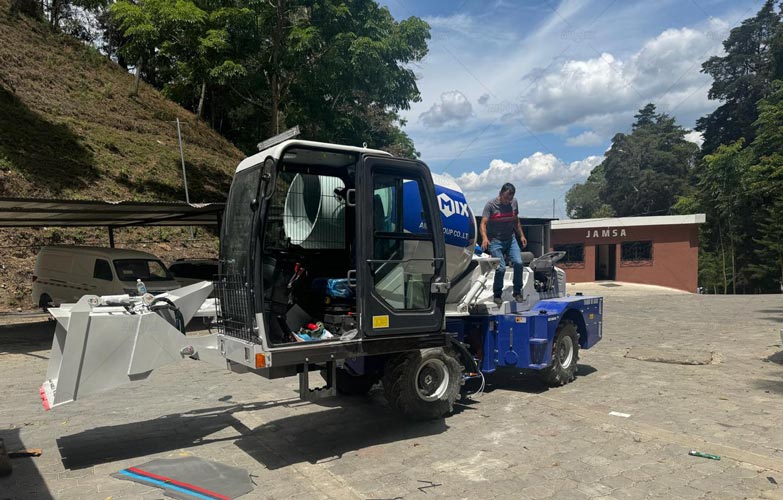
A self-loading concrete mixer(auto hormigonera) allows operators to produce concrete directly at the work site. Aggregates, cement, and water are loaded into the machine, mixed in the rotating drum, and discharged immediately where needed. This on-site production capability helps municipalities avoid delays associated with concrete transportation.
Limited Budget and Equipment Resources
Municipal budgets are often constrained, especially in smaller cities or developing regions. Public works departments must balance equipment purchases with operational efficiency. Investing in multiple specialized machines may not be feasible.
Because a self-loading concrete mixer combines several functions in a single unit, it reduces the need for additional equipment such as loaders, mixers, or transport trucks. This integrated design can significantly lower overall project costs.
Fast Response for Emergency Repairs
Municipal repair teams frequently respond to urgent situations such as road damage after heavy rain, broken curbs, or infrastructure deterioration. Equipment that can be mobilized quickly is essential for minimizing disruption to traffic and public services.
Self-loading mixers are designed to move easily between job sites, allowing crews to produce concrete immediately without waiting for external supply.
Understanding the Price Structure of Self-Loading Concrete Mixers
To evaluate whether the equipment is competitive for municipal use, it is important to examine the factors that influence pricing.
Machine Capacity and Configuration
Self-loading mixers are available in several capacity ranges, typically from 1.2 cubic meters to 6.5 cubic meters per batch. Smaller models are often sufficient for municipal maintenance tasks such as pavement repair, curb installation, or small foundation work.
Lower-capacity machines generally require a smaller investment, making them attractive for city governments seeking affordable equipment.
Technology and Automation Features
Modern models may include features such as electronic weighing systems, automatic water control, hydraulic steering, and four-wheel drive capabilities. These technologies improve mixing accuracy and operational efficiency but can slightly increase the initial purchase price.
However, when evaluating a self-loading concrete mixer for sale, it is important to consider how these features contribute to productivity and reduce human error.
Transportation and Import Costs
For municipalities in Latin America, logistics and import duties can also affect the final purchase price. Shipping distance, local taxes, and dealer distribution networks may influence equipment affordability in different countries.
Operational Advantages for Municipal Construction Teams
Beyond the initial purchase price, the operational benefits of self-loading mixers often make them a cost-effective solution for municipal repair projects.
Reduced Labor Requirements
Traditional small concrete operations often require multiple workers to load materials, mix concrete, and transport it to the work area. With a self-loading concrete mixer, a single operator can perform most of these tasks.
This reduction in labor requirements can significantly lower operating costs over the life cycle of the equipment.
Improved Project Flexibility
Municipal repair teams frequently encounter unpredictable site conditions. Road closures, narrow streets, and limited workspace may restrict the use of large construction equipment.
Self-loading mixers are compact and highly maneuverable, allowing them to operate efficiently in urban environments where larger machines cannot easily access.
Lower Concrete Waste
Ready-mix concrete must usually be ordered in minimum quantities, which can lead to material waste if the project requires only a small volume. On-site mixing allows operators to produce only the exact amount of concrete required.
This precise production capability reduces both material waste and project costs.
Growing Demand in Latin American Municipal Markets
Across Latin America, urban infrastructure maintenance has become a priority for many local governments. Roads, drainage systems, and public facilities require regular repair to support economic growth and urban development.
Applications in Bolivia
Municipal infrastructure projects in Bolivia often occur in geographically diverse environments, including mountainous regions and remote towns. Equipment mobility is essential for reaching different project locations.
In this context, the self loading concrete mixer Bolivia(auto hormigonera Bolivia) market has gradually expanded as local contractors and municipal departments look for practical equipment solutions that can operate independently without large supporting infrastructure.
Infrastructure Maintenance in Paraguay
Similarly, many cities in Paraguay face ongoing road maintenance challenges due to weather conditions and increasing urban traffic. Municipal repair teams must frequently restore pavement sections, drainage channels, and small concrete structures.
The self-loading concrete mixer Paraguay market is growing because the equipment enables on-site concrete production, allowing repair crews to complete projects more efficiently.
Adaptability to Local Construction Conditions
One of the key advantages of self-loading mixers in Latin America is their adaptability. Many municipal projects take place in areas where large batching plants or ready-mix delivery services are not readily available.
Self-loading mixers provide a practical alternative by enabling independent concrete production directly at the job site.
Long-Term Cost Efficiency
When evaluating equipment investment, municipal authorities must consider long-term financial implications rather than focusing solely on initial purchase price.
Lower Transportation Costs
Transporting ready-mix concrete from distant plants can be expensive, especially when projects involve small volumes. Producing concrete on site eliminates these transportation expenses.
This advantage becomes particularly significant for municipalities managing frequent small repair tasks throughout the year.
Increased Equipment Utilization
Because municipal repair projects occur continuously, a self-loading concrete mixer can remain in regular operation throughout the year. High utilization rates improve the return on investment for the equipment.
Reduced Dependence on External Suppliers
By producing concrete independently, municipalities reduce their reliance on commercial ready-mix suppliers. This independence can improve scheduling flexibility and reduce delays caused by supply shortages.
Conclusion
Municipal repair projects require equipment that combines flexibility, affordability, and operational efficiency. While the initial purchase price is an important factor, the overall economic value of a machine depends on its ability to reduce labor costs, improve mobility, and streamline construction processes.
The self-loading concrete mixer offers a compelling solution for many municipal maintenance teams. Its integrated design allows on-site concrete production while minimizing the need for additional equipment or complex logistics.
For cities evaluating a self-loading concrete mixer for sale, the machine often proves to be a competitive investment when considering long-term operating costs and project efficiency. Growing demand in markets such as the self loading concrete mixer Bolivia sector and the self-loading concrete mixer Paraguay(autohormigonera Paraguay) market demonstrates the practical value of this equipment in municipal construction environments.
As urban infrastructure maintenance continues to expand across Latin America, self-loading mixers are likely to remain an increasingly attractive option for municipal repair operations seeking reliable, flexible, and cost-effective equipment solutions.