
The Malaysian construction equipment market is witnessing a discernible shift. Established preferences for Japanese and European concrete pumping machinery are being actively challenged by a surge in adoption of Chinese-manufactured cement mixer pump. This trend is frequently dismissed by incumbent suppliers as mere price-driven commoditization—a race to the bottom where upfront cost trumps all other considerations. This characterization is not only reductive but intellectually lazy. It ignores a more complex and compelling reality: that leading Chinese manufacturers have systematically closed the technical gap while preserving their cost structure advantage, creating a value proposition that is increasingly irresistible to rational, profit-motivated builders. The migration toward Chinese equipment is not a surrender of quality for savings; it is a sophisticated recalibration of procurement strategy that recognizes the shifting geometry of performance, price, and lifecycle cost. This analysis examines the three pillars of this transformation.
The Price Gap: From Marginal Differential to Value Disruption
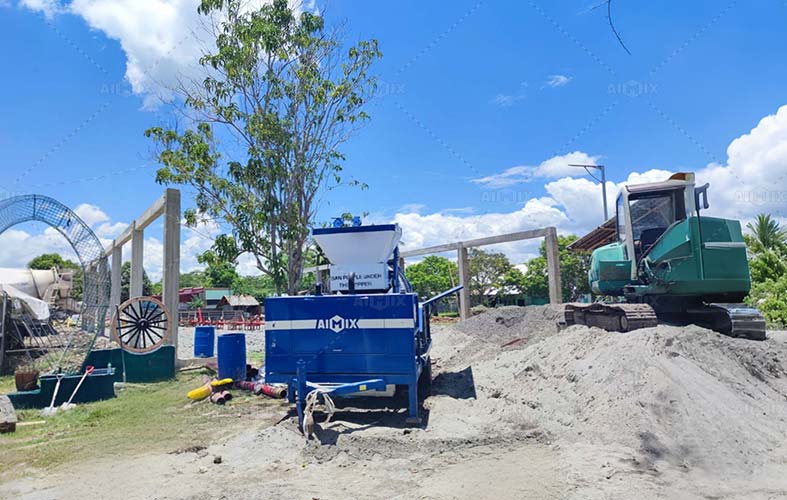
To understand the current market dynamics, one must first abandon the assumption that “cheaper” implies “inferior value.” The concrete mixer with pump price differential between Chinese and established European or Japanese brands has evolved from a modest discount into a structural advantage that fundamentally rewrites the ROI equation.
Deconstructing the Cost Structure Advantage
Chinese manufacturers operate within an industrial ecosystem that confers profound cost advantages not easily replicated by their competitors. This is not merely about lower labor costs—a shrinking advantage. It encompasses vertically integrated supply chains where component manufacturing, sub-assembly, and final integration occur within concentrated geographic clusters. A Chinese pump manufacturer can source its hydraulic pumps, gearboxes, and electronic controllers from specialized domestic suppliers operating at enormous scale, achieving cost efficiencies that European manufacturers, reliant on fragmented, lower-volume supply networks, cannot match. This structural advantage translates into landed costs in Port Klang or Penang that undercut equivalent Japanese models by 30-45%. At this differential, the traditional “buy once, cry once” argument for premium brands becomes mathematically untenable.
The Inflection Point: When Lower Price Enables Superior Fleet Strategy
Malaysian contractors are sophisticated financial operators. They recognize that a 40% lower capital outlay for a Chinese pump with 80% of the theoretical service life of a premium competitor delivers superior capital efficiency. More critically, this pricing enables fleet stratification. A contractor can deploy a premium European pump on critical, high-visibility infrastructure projects while simultaneously fielding two Chinese units for the broader portfolio of commercial and residential works. This blended approach optimizes both capital allocation and risk distribution. The decision is not Honda versus Proton; it is a calculated portfolio strategy enabled by a new price reality.
Technical Parity: Closing the Performance Gap
The argument that Chinese pumps succeed solely on price collapses under examination of their technical evolution. The performance gap that once legitimately concerned buyers has been substantially, and in many segments completely, eliminated.
Component Sourcing and Technology Transfer
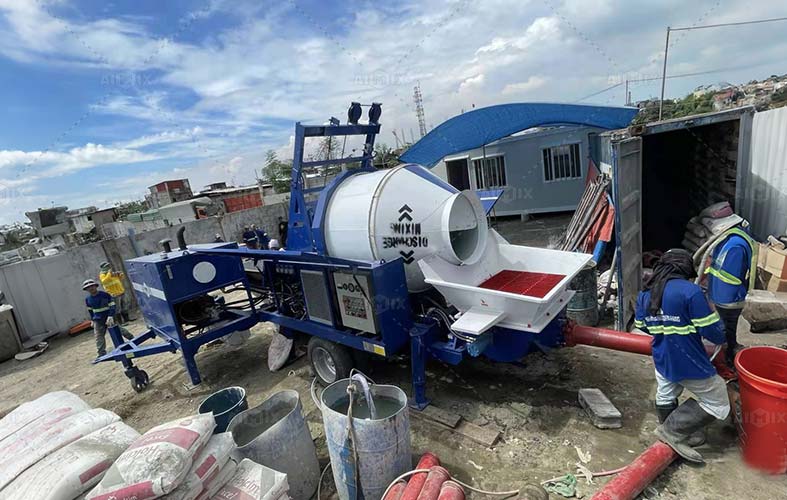
The modern Chinese cement mixer pump is a global machine. Leading manufacturers now source critical components from the same global suppliers serving European and Japanese OEMs. Hydraulic pumps from Rexroth or Kawasaki, diesel engines from Cummins or Deutz, and programmable logic controllers from Siemens or Schneider Electric are increasingly common specifications on Chinese-built equipment. This convergence of component provenance directly translates into convergence of performance and reliability. When a Chinese mini concrete pump for sale is fitted with the same German hydraulic pump and the same Swedish steel in its wear components as its European counterpart, the residual performance differential is attributable almost entirely to system integration—a gap that has narrowed dramatically through two decades of accumulated engineering experience and, in many cases, direct technology transfer partnerships with former industry leaders.
Adaptation to Local Operating Conditions
There is a compelling argument that certain Chinese manufacturers now exhibit superior adaptation to Southeast Asian operating environments. Malaysian construction sites impose unique demands: high ambient temperatures, variable fuel quality, and aggregates with inconsistent moisture content. European and Japanese equipment, engineered primarily for temperate, controlled environments, can exhibit sensitivity to these conditions. Leading Chinese manufacturers, whose domestic market includes extreme geographic and climatic diversity, have developed robust systems tolerant of fuel contamination, high particulate loads, and operator skill variations. This suitability—not price alone—is a primary driver of adoption among Malaysian contractors who require equipment that performs reliably under local conditions, not theoretical laboratory specifications.
After-Sales Calculus: The Shifting Support Paradigm
The final and most contentious dimension of this analysis concerns after-sales support. The historical argument against Chinese equipment centered on parts availability, technical documentation, and service network inadequacy. This criticism, once valid, is increasingly obsolete.
The Localization of Support Infrastructure
Recognizing the strategic importance of the ASEAN market, major Chinese manufacturers have invested substantially in localized support infrastructure. Authorized dealerships in Malaysia now maintain significant parts inventories, employ factory-trained technicians, and offer comprehensive warranty programs comparable to established brands. The response time for critical spare parts has compressed from weeks to days, and in major urban centers, hours. This infrastructure investment fundamentally alters the risk calculus. The total cost of ownership, incorporating downtime risk and maintenance expenditure, now frequently favors the Chinese option when evaluated over a five-year horizon.
Warranty Certainty and Commercial Accountability
Equally significant is the maturation of commercial practices. Contemporary supply agreements from reputable Chinese manufacturers offer unambiguous warranty terms, defined service level commitments, and clear dispute resolution mechanisms. The era of opaque transactions and unenforceable promises is receding. Malaysian builders now procure Chinese equipment with contractual certainty comparable to that offered by European suppliers. This convergence of commercial professionalism, technical capability, and structural pricing advantage creates an overwhelming cumulative case. The shift toward Chinese concrete mixer pump in Malaysia is not a temporary aberration driven by recessionary cost-cutting. It is a permanent structural realignment of the equipment market, reflecting the emergence of legitimate, high-value alternatives to the established industrial order. Malaysian builders are not simply spending less; they are buying smarter.